
2017–2021 / New Orleans + online
Beaubourg School was a tuition-free school based in New Orleans that created space to share and learn. It connected people interested in transforming their community through self-exploration, knowledge sharing, and creative action.
The core model was simple: every teacher was paid a flat rate per class, and classes were always tuition-free for participants. The school also partnered with other New Orleans institutions to create exchanges and encounters rooted in academic integrity.
Developed with David Williams of Beaubourg Theatre as Christopher Givens’ Tulane Mellon community-engaged project, the school launched in Fall 2019 with free courses led by ten teachers and attended by more than 150 students. Its second semester expanded to thirty teachers at four partner locations. By its third year, the school had paid more than $9,000 to local teachers and engaged more than 600 students in New Orleans and across the globe—including Singapore, Toronto, Zimbabwe, and France.
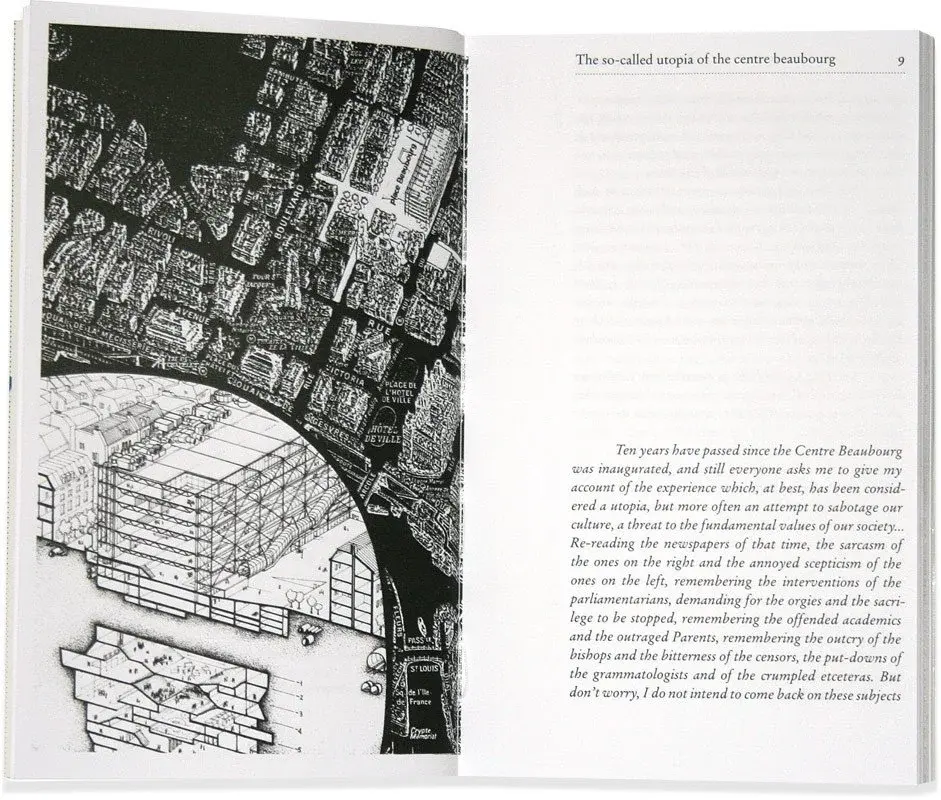
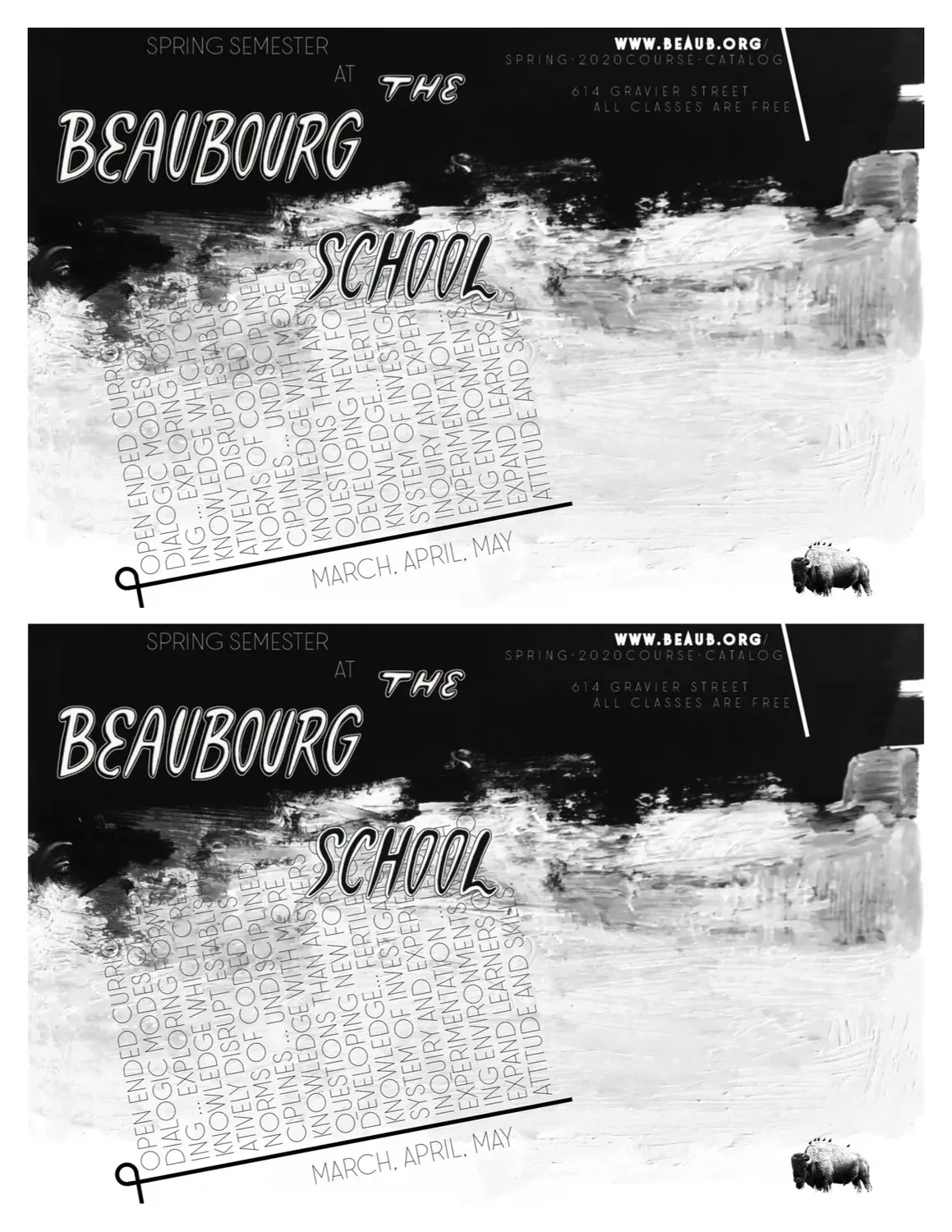
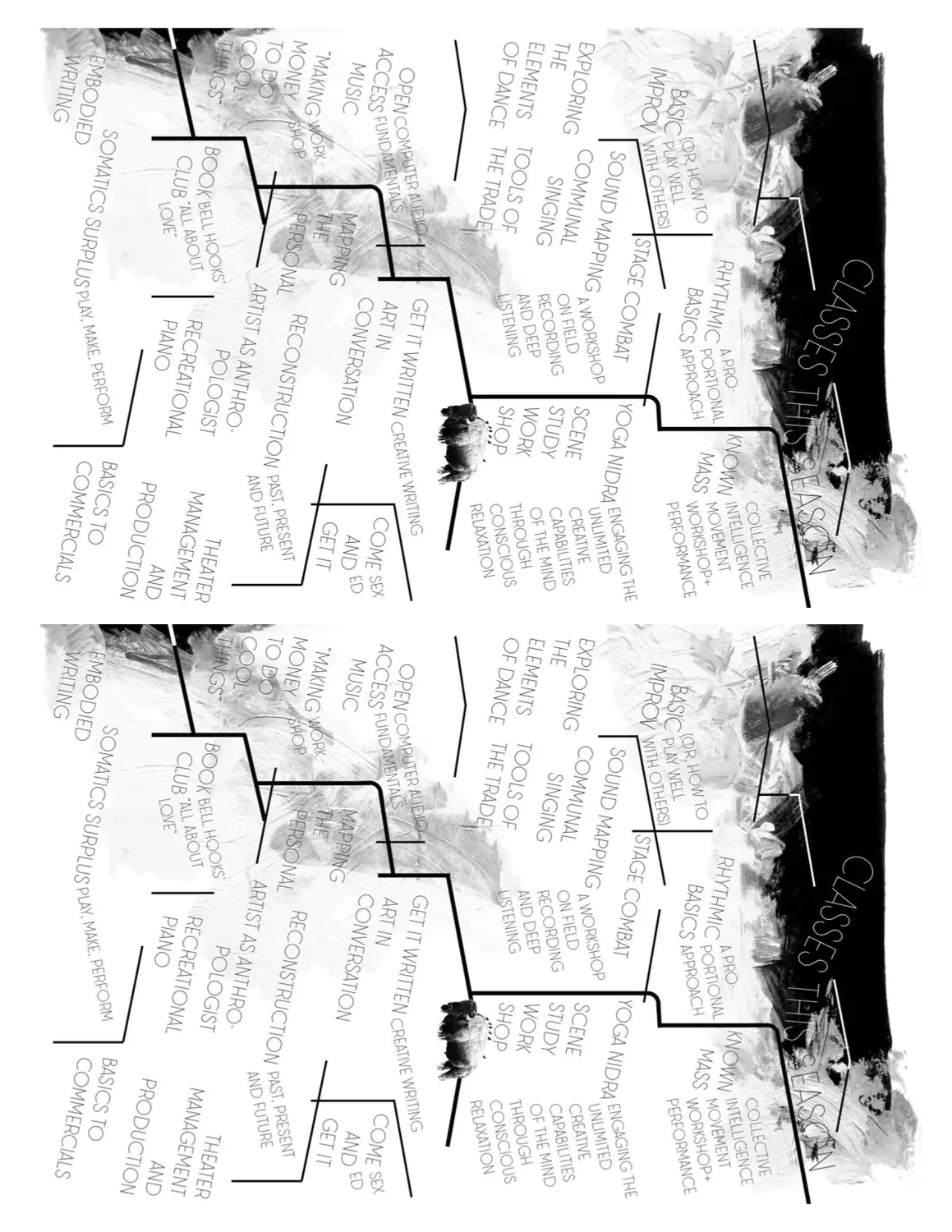
Example Course Catalogs
Spring 2020
Mapping the PersonalCamilla Sobral · 3 weeks
Over the next 3 classes we will be working on making our own maps - of our current, past, or future. Maps of where we used to live, intimate spaces, personal landmarks, maps of memories. How can we create a document that transcends time and place to connect the personal and collective? We will be working with collage, creative writing, found materials, photographs, personal memorabilia to build a visual map that reflects you. The pieces created in this workshop will become part of an online archive where future participants can contribute work and it will remain as a resource for the public.
Biography
Certified Social & Emotional Arts facilitator, Camila Sobral explores themes of identity, memory, and storytelling within mixed media practices. She has previous experience working in non-profit arts organizations, facilitating art workshops, curatorial work, and teaching. She is a firm believer in facilitating opportunities for people to find joy and self-reflection through creativity.
Questions
- How can we create a map that represents how we engage with our neighborhood? What would it look like?
- What would a map that reflects our everyday experience look like?
- What are your personal landmarks? If you could put a memory on the map, what would it be and what would it look like?
- How do our personal experiences shape the way we engage with our everyday surroundings?
Reconstruction: Past, Present, and FutureChris Daemmrich · 5–6 weeks · 90 mins · 5:30–7:30pm
During the period of Reconstruction, from 1862 to 1877, New Orleanians of many backgrounds fought to establish conditions of political and social equality for people of African descent. These efforts were fought and ultimately violently suppressed by ex-Confederate White supremacists, and its true history was obscured by racist mythology. Students in this course will learn about political and social histories of Reconstruction in the city of New Orleans through visits to historically significant sites, engagement with primary and secondary sources, dialogue and the production of artistic responses to these stories and their erasure from the historical record.
Biography
Chris Daemmrich grew up in Austin, Texas on land taken from the Tonkawa people. He studied architecture and political science at Tulane, graduating in 2017. As a writer, consultant and design facilitator through his practice, the Just Architecture Workshop (JAWS*), Chris participates in creating antiracist, queer, feminist space. Chris has experience in political, design and development work. Find him on Twitter and Instagram @sodaemmgood
Questions
- What was it like to be a resident of New Orleans during the Civil War and the First Reconstruction?
- In what buildings, places, spaces and institutions did the First Reconstruction play out in New Orleans?
- How did White supremacist politics and political violence crush the First Reconstruction?
- How is the First Reconstruction remembered, and not remembered? What effects has this had on the Second and Third Reconstructions?
- What would a Reconstructed New Orleans look like? A Reconstructed United States?
Basic Improv (Or, How to Play Well With Others)Carrie Moulder · 4 weeks · 2 hours
As an introvert, the idea of working on a team is daunting. Who are we kidding? Working in a team is difficult for everyone. But, when you apply the "yes, and" principle of improv, our ability to collaborate in a positive and productive way can increase. As creatives working together to build something beautiful, we need others to help, to solve problems, or to grow an idea, and all of that starts with listening, accepting, and adding to what others have to offer. Applying a few easy-to-implement principles of improv can improve collaboration even in the most diverse and headstrong teams. This workshop guides participants through improv exercises that focus on listening, accepting, and endowments. The experience gained can easily be transitioned into any endeavor where successful teamwork is critical to success.
Biography
Having fallen in love with improv in January of 2015, Carrie Moulder currently co-produces the all-female podcast Neon Clubhouse, performs with the New Orleans-based troupe Killjoy Associates, volunteers with Funny Bones Improv, teaches with Wit / Craft Improv Studio, and makes herself available for improv and sketch comedy shows that her friends produce. Originally from Texas but deeply grateful for her 20-plus years in New Orleans, she prefers sunsets over sunrises, loves ice cream, will play a board game at a moment’s notice, and doesn't care what she looks like when she dances (because she's doing it anyway). Ask her about traveling or her miniature Schnauzer Otto to experience the full breadth of her joy.
Questions
- How can I be present in a creative or teamwork session to truly listen to and understand what's being offered?
- How can I value another person's idea or contribution to my team, even when my first inclination is to disagree or dismiss?
- How can I build upon the ideas of others with specificity and positivity?
- How can I listen to and value my own contributions in the spirit of creativity and collaboration?
Somatics Surplus: Play, Make, PerformRhia Jade · 5 weeks
Through guided improvisation, play, somatic exercises, and composition prompts, we will grow our embodiment practice while building a collective dance score. We will learn about the connection between our bodies and minds with two goals: to demystify the practice of getting in our bodies and to build courage for being seen. Come ready to move, laugh, and connect to yourself and others. This series will culminate in a public informal performance to share what we have built together.
Biography
Rhia Jade (they/them) is a Korean-American choreographer, dancer, and performer based between New Orleans and Los Angeles who cultivates a practice at the crossroads of queerness, intersectional feminism, choreography, video, and performance. Rhia’s dance-works have been presented in New Orleans at the Contemporary Arts Center, Marigny Opera House, Catapult, and Port, and in Los Angeles at REDCAT, Human Resources, Pieter, and Highways. They are a member of the Asian heritage collective ThisOrientation facilitated by Ryuta Iwashita, have performed Trisha Brown's Floor of the Forest, and can be seen dancing on the Hulu series CLAWS. Rhia holds a BA in World Arts and Cultures/Dance from UCLA.
Questions
- what does it mean to “be in your body” and how can you do it?
- how does mindfulness combine with play to bring forth positive psychological growth?
- how can we normalize being truly seen, whether seeing our own self or seeing each one another?
- how come dancing is so fun and makes me feel so good?!
Theatre Management and ProducingTiffany Vega-Gibson · 6 weeks
This course is catered to working performance artists and those who are interested in working in the performing arts/arts administration field. It is one of my missions in life to make sure that every artist understands the business of performing arts. So many artists are taken advantage of by professionals in this industry and I am very passionate about artists knowing how the business works so that they can protect themselves and their art.
Through this course, students learn the following:
- Copyright Law and Intellectual Property: The basics of copyright law and how to protect your intellectual property (aka your art).
- Performing Arts Contracts: The different types of contracts that exist in the performing arts, how to read them, and how to negotiate terms (aka how to get what you want). Contract templates are provided.
- Production Budgets: How to read and create production budgets, income sheets, and recoupment charts (aka figure out how much your production will cost and how much you should charge for tickets in order to make a profit). Budget templates are provided.
- How Nonprofit Arts Organizations Work: The ins and outs of nonprofit arts organizations. This course is for those who are interested in starting their own nonprofit arts company or working in arts administration.
- Personal Budgeting and Finance for the Artist: AKA how to live while being a working artist. Budget templates are provided.
Are you a theatre artist that is interested in learning more about how to run your own nonprofit theatre company or produce your own production(s)? Are you interested in learning how to read or write employment contracts? Have you created intellectual property and have no knowledge of copyright law or how to protect this work? Are you interested in learning more about how to create a production budget? Are you interested in learning more about how to manage your personal finances while working as an artists and want some advice in how to advance in their industry?
Biography
Tiffany Vega-Gibson currently works as an Enterprise Account Manager with AudienceView. She also works as an independent consultant through her performing arts management company, La Vega Management, which has worked with dozens of performing arts organizations in New York, Washington, DC, and New Orleans. She currently serves on the Steering Committee for the New Orleans based theatre company, No Dream Deferred, and is a trained Equity, Diversity, and Inclusion facilitator through artEquity. Previously, she was the General Manager at Hi-ARTS (Formerly Hip-Hop Theater Festival). Tiffany is experienced in organizational management, fundraising, fiscal development, and community relations. She has worked both on the presenting and producing side of performing arts as well as tour management and holds an MFA in Theatre Management & Producing from Columbia University and a BA in Theatre Performance from the University of Maryland-College Park.
Sound Mapping: A workshop on field recording and deep listeningMary Scott · First 4 Sundays of March
Ever get lost in the sounds of your surroundings? You may have been practicing deep listening! Improve your creative ear in this class that explores the worlds of deep listening and field recording. This class is designed to provide a space for deep sonic exploration, discussion, and meditation. Participants will document the surrounding soundscape using basic field recording techniques and have the opportunity to create their own experimental music piece. This introductory class is designed for people from all backgrounds who feel they could benefit from practicing a more critical form of listening. Discovering experimental music created with field recordings and non-traditional sound structure changed the game for me as a young jazz musician, maybe this is the extra inspiration you need to explode your creative practice.
Biography
Mary Scott is a musician and educator based in New Orleans, Louisiana. They have toured and played numerous shows as Dolce, an experimental electronic project that weaves layers of feedback and field recordings into lush soundscapes. Sets range from blistering and unlistenable to delicate and tender. Aside from shows, Mary is also a teacher. While studying, they fixated over anything related to sound studies, how we experience sound in our day-to-day lives and immersion in deep sonic experiences. In 2019, they completed a Fulbright grant teaching English language and sound in Brazil. Along with teaching language, they taught classes on deep listening and sound in culture. They are seeking opportunities in the future to continue teaching sound as a tool for critical thinking and reflection, in and around ourselves.
Questions
- How often are you passively listening versus consciously listening?
- What kind of soundscape do you seek when you’re working on your creative practice? What about for your living space?
- What soundscape do you prefer when you want to relax or take a break?
- What is the difference between Deep Listening and meditation?
Open Access Music: Computer Audio FundamentalsPeter J Bowling
Have you ever wanted to make music with your computer but couldn't figure out how to get started? Have you spent countless hours searching youtube for the right tutorial to give you very basic information? Computer Audio Fundamentals is designed for all levels and experiences to learn & deepen fundamental knowledge about computer audio and then apply it directly to creative projects by using only free(ish) & open source resources. Through a combination of lectures and lab periods, students will learn how to use their computer for live music/DJ-ing, music production, film scoring, theatrical sound design, and much more. A computer is required. Priority registration for queer people, POC, & women.
Biography
Peter J Bowling (He/Him) is a self-taught computer musician & multi-instrumentalist improviser, producer, composer, designer & collaborator based in New Orleans. He holds advanced degrees and 3+ years of college-level teaching experience in an entirely unrelated field.
Questions
- Have you ever wanted to make music with your computer but don’t know how?
- Have you spent countless hours on youtube trying to teach yourself audio production?
August 2020 8 online workshops and forums
Turning Pages: A healthy masculinity workshop - 8/5Té V. Smith
Toxic masculinity is a term for some of the dangerous associations of “maleness” in our culture. It doesn’t mean that masculinity is bad or that it is bad to be a man. It does mean, however, that many of the traits associated with masculinity in our culture are dangerous or toxic for both men and women’s mental, physical, emotional, and relationship health and let’s be honest; the difference between healthy & toxic masculinity can be and has been a matter of life or death in some cases. Turning Pages is a Healthy Masculinity workshop dedicated to addressing and implementing healthy practices and monitoring progress of boys and men.
Té V. Smith is a Nigerian American writer who focuses on the themes of healthy masculinity, mental health, and education reform. He has written two books, a collection of poetry & prose, 'Here We Are, Reflections of A God Gone Mad' (2017 R.H. Austin Publishing) and a Young Adult novel, 'Exit Ticket' (2019 Field Order Press). His work has been published in or are forthcoming in Tin House, Kingdoms In The Wild, Black Girl In Ohm, Blackbird and more.
Stardust en el Sur: A music history and movement class - 8/8 at 11amMoréna Espiritual
Stardust en el Sur is a healing movement workshop made to honor indigenous ways of relating through dance in order to promote a mind-body-soul consciousness that is expansive and accessible to anyone; no prior knowledge or skill set required. It’s name came to be because all music danced to and learned about in this class are by Afrolatinx creators. Join us in this pop up session focused on the Rap in Español as we muse on it’s political evolution to answer the question: What does it mean to be daring and how can we use this framework to unlock new potential within movement? Come prepared to brainstorm, learn some history, and then apply your conclusions through some brand new, self-made dance moves.
Moréna Espiritual (they/them) is a queer Afro-Taíno teaching artist, performer, and organizer. Their family is from Puerto Plata, Dominican Republic, while they were raised mostly in Harlem, New York. They have performed at venues like the Brooklyn Academy of Music (2014) and New York Live Arts (2016), and their work has been part of an exhibition at the VisArts museum in Rockville, Maryland. They are a recent Teaching Artist Project fellow - a self-reflective program developed by Community Word Project to deepen their social justice-based pedagogy. Currently they teach "Stardust en el Sur" - a healing dance class that mixes political education, movement, and reflection in order to unlock kinetic medicine for its participants while uplifting the legacy of the Afro-diasporic genres of Latin America. Stardust has been taught at the Langston Hughes House, Sarah Lawrence College, with the collective Radical Love Consciousness, and as community classes at the Church of St. Timothy and St. Mathew’s.
NoiseFilter - 8/12 at 6pmMarkAlain Déry
COVID-19 updates as seen through the filter of Social, Economic and Racial Justice.
MarkAlain Dery, DO, MPH, FACOI is an infectious diseases physician and epidemiologist who is the founder of community radio station 102.3FM WHIV-LP, a station dedicated to human rights and social justice. You don't have to wait to hear what he's up to, though: with Dr Eric Griggs ("Doc Griggs"), he has a daily, ten minute podcast NoiseFilter on COVID-19. Find it on Spotify.
Somatic Presence for Creative Communication - 8/15 at 10amTim Kooken
This workshop will be an exploration into the presence of our bodies. The body remembers. The body is an amalgamation of histories and stories and memories which go beyond our lifetime. The body is relational, interpersonal, cultural. Through sensory activation, awareness practice, meditative movement, discussion, and mindful communication, we will explore the somatic, in all its creative and psychosocial entanglements. Presencing is focused on awakening and/or continuing a process. Life is process, presence is process. This will differentiate 'presence' from the 'present' as something dynamic with time. We will explore how we relate with and through space, and how our bodies inform mindful choices in interpersonal communication. Your body and your presence is all that is required.
Majak Qigong aka T.T. Kooken (they/them) is a Genderqueer facilitator and teacher of many embodiment modalities. From martial arts, meditation, breathwork, and fitness, to improvisation, performance, creativity, and ritual, they are focused on bringing healing through Somatic awareness and practice. In keeping with the spirit of Qigong as “Energy Cultivation”, they coalesce areas of experience to cultivate energy and develop deeper humanity. They're committed to working with nature, against the patriarchy, and towards a greater awareness of body knowledge, energy, and experience. They are a full-time parent, explorer, and student of living practice.
School Reimagined - 8/19 at 6pmAndrea Heard
How is Virtual Instruction going for teachers? What are the benefits and challenges of Remote Learning? Andrea has kept her eyes on the changing learning landscape and wants to provide tips and insights that can make the experience better for teachers, students, and parents.
Andrea is a native New Orleanian who has taught here for the past 10 years. Beginning in elementary, then moving forward to high school, and now teaching collegiately at Southern University at New Orleans and also Delgado Community College. Once leaving teaching in the charter school movement in 2017, she began a blog called Ask Miss Heard . It began with writings to help support parents and also novice teachers navigate our current education system. From there, she continued with weekly LIVE shows via social media sites. All of those pieces have led up to her recent work and docuseries project. Here she fuses her background in film with her experiences in education. She has 10 shows total that will air later this year.
Manifestos - 8/22 at 11amDax Bram
This workshop/class explores notable manifestos and the concept of manifesting. Students will workshop their own manifesto by the end of the session(s).
DB is an interdisciplinary PhD student in cultural anthropology and a Mellon Graduate Fellow in Community-Engaged Scholarship at Tulane University.
Exploring the Elements of Dance - 8/26 at 6pmJalisa Roberts
What does a dancer do? At its core, dance is moving through space and time with energy. The class will explore a couple of the five elements of dance (body, action, space, time, and energy), creating short movement phrases through structured improvisation. This class is designed for dancers as well as ‘non-dancers’.
Jalisa Roberts is a writer, educator, Black Studies scholar, singer, and choreographer; and explores how all of these different artistic interests live in one body and influence each other. Her choreography sparks conversations on identity and memory. Much of Jalisa's work explores how individuals relate to and influence groups, and how our narratives on similar events can differ greatly based on our individual experiences.
Anti-racist Book Club - 8/29 at 11amAmelia Parenteau
Join the Anti-Racist Book Club for an introductory conversation about equity, diversity, and inclusion. Prior to class, we'll read excerpts from texts seminal to anti-racist work by authors Ta-Nehisi Coates, Robin DiAngelo, and Reni Eddo-Lodge. In our workshop discussion, we will explore strategies to incorporate anti-racist practice into our daily life. Texts will be provided free of charge.
Amelia Parenteau is a freelance writer, translator, and theater maker based in New Orleans with a focus on Equity, Diversity, and Inclusion. An alumna of Sarah Lawrence College, she has worked with TCG, Ping Chong + Company, The Lark, The Civilians, the French Institute Alliance Française, Voyage Theater Company, and The Park Avenue Armory in New York; People's Light in Pennsylvania; the Eugene O'Neill Theater Center in Connecticut; and Théâtre du Soleil in France. She has translated dramatic works by Leslie Kaplan, Alain Foix, Sedef Ecer, the Théâtre du Soleil, David Lescot, and Charlotte Boimare & Magali Solignat. She is a member of the FENCE International Translation Network, ATLAS, and TCG, and she has been published in several magazines and journals including American Theatre Magazine, Asymptote Literary Magazine, Contemporary Theatre Review, Culturebot, HowlRound, and The Mercurian.
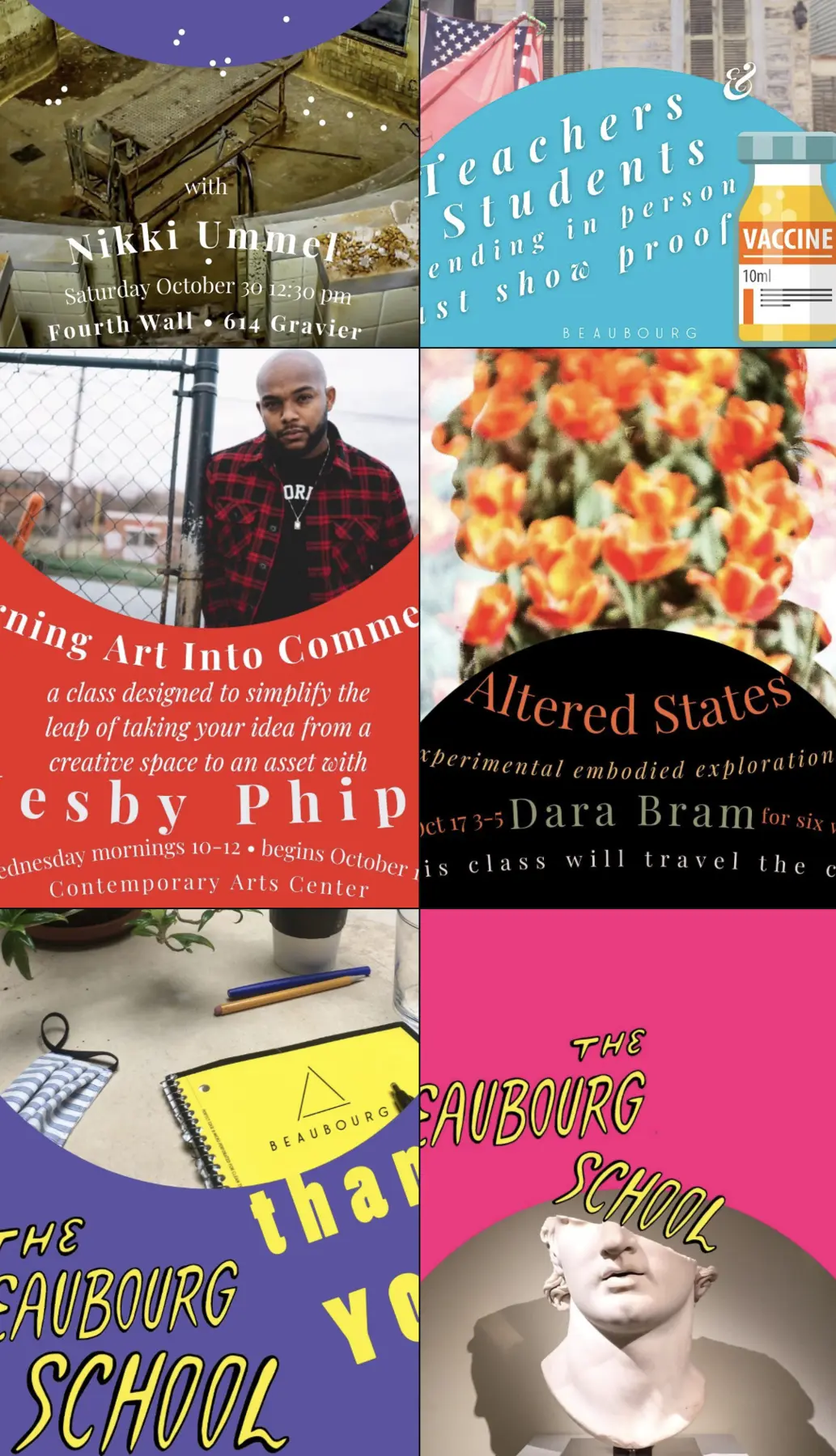
Fall 2021 8 course listings
- Turning Art Into Commerce
- Nesby Phips
- Altered States
- Dara Bram
- The City of Spectacle
- Javier Marcano
- (The) Body at Play
- Grace Woodford
- Building Daily Practices & Cultivating Creative Attention
- Rey Hope
- Purposeful Play
- Monique Rooker
- Thoughtful Trust & Estate Planning Just in Case You Don't Live Forever
- Okyeame Haley
- Embodied Poetics: A creative writing & movement series
- TT Kooken
A school shaped by its participants Teaching model and pandemic-era collaborations
The school’s open curriculum grew from the needs and imaginations of its communities. Experienced educators and first-time teachers could propose a class, workshop, lecture, or experiment; participants could also request subjects they wanted to learn. Classes were tuition-free, with a $40 stipend for teachers per class. The program connected artistic and social research with experience, practice, and collective inquiry.
During summer 2020, the school moved into online workshops and open forums. Alongside writing, dance, and embodied practices, the August program made space for conversations about healthy masculinity, anti-racism, remote education, and COVID-19 through the lens of social, economic, and racial justice. Workshops used registration and teacher-defined class limits; the public forums did not require registration.
In spring 2020, Beaubourg also collaborated with Rachel Nelson at Bard Early College New Orleans and No Dream Deferred on a semester-long course in writing and performance. Students wrote, directed, and performed The Circle, connecting their academic work with reflection on their own identities. Originally intended for a public performance at Beaubourg Theatre in April, the piece was adapted for Zoom and performed on May 6, 2020, with support from Tulane’s Mellon Graduate Program in Community-Engaged Scholarship.
Sources: School, August 2020 program; Beaubourg homepage, archived March 2021.
a free school of the south / a place to probe the possible and pollinate tomorrow